02 June 2008

[ final post ]


As I mentioned before, David Lynch has invaded my brain in much the same way as robots did before, so I'm going to incorporate him into my final post too. Having seen all the strange/experimental stuff he is always using I've recently been sort of interested in filmmaking. It seems like a good choice for a class.
The supplemental text used for this class would be David Lynch's Catching the Big Fish, which is basically about how he gets all his crazy ideas. He reflects on various experiences he's had making films, his favourite actors and such. The most interesting part is probably his discussion of Transcendental Meditation, which he has practised since the '70s, and from which he apparently gets a good deal of his ideas (another big one would be improvisation). We wouldn't necessarily be learning TM (though David Lynch actually has a "David Lynch Foundation" that provides scholarships for students to learn it so it is a possibility actually) but the book is a good way to learn about the creative process that goes into filmmaking.
The class would be in the form of a blog using a format similar to this one. There would be sporadic assignments (much fewer than the amount for this class, because we would do other work) on the blog such as searching out and posting about a film blog. Every week there would be an assigned feature-length movie, which we would meet to watch (that would be the only time, per week, that we would meet) and sometimes also a short. The short (either amateur or professional) would preferably be on YouTube, for the students to watch on their own time, but if it wasn't available on the internet we would have a second (short) meeting to watch it. The students would discuss immediately after watching the movies, then later reflect about them on their blogs.
At the end of each nine-week period (it would probably be a two-semester class) everyone would make their own short film, preferably about a different thing each time (documentary, faux commercial, animation...). The midterm would probably be a longer and more serious attempt, possibly in groups, and I'm picturing for the final the whole class gets together and makes one huge movie and posts it on YouTube (though all of them would be posted on YouTube I guess).
So anyway, I suppose the students would be evaluated mostly by their reflections on the movies they watch...and of course the shorts that they make. And that's it, really. I think it's a good class idea and even for students with no plans to go into film it could potentially be a good creative experience.

18 May 2008

[ the opp ]

Commenting on Laura's post (Chuck Palahniuk) this week.
That kind of stuff happens to me all the time, probably because my computer is nearly as ancient as the ones in the Powder Room (it can't be newer than six or seven years old...and I think the hard drive has had to be completely replaced twice). Anyway, I actually haven't read any Palahniuk books before but I generally love postmodern literature (The Raw Shark Texts, which I posted about, comes to mind, as does House of Leaves). Right now I'm not reading anything too postmodern, just the final Dune book plus Huckleberry Finn for Essential Books, but I do have a book on reserve at the library called The Quiet Girl (by Peter Høeg) which is about a Danish clown, suspicious psychic children, and nuns. It's actually been criticised for being too postmodern, which to be honest makes me want to read it more. Any suggestions for other books?

17 May 2008

[ the oc part ii ]

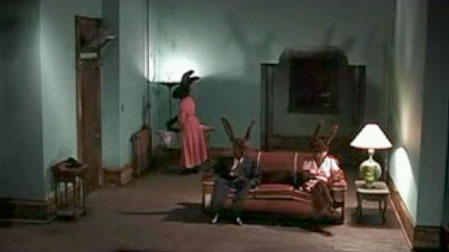
Earlier in this class you probably got tired of me talking about robots; well, now you can be tired of me posting about David Lynch, because I'm doing it again. Anyway, his first movie was Eraserhead, which is totally incomprehensible and largely lacks a plot. It's a horror movie, but it's so bizarre that to anyone who hasn't seen it it sounds like a comedy. This is summed up nicely by TV Tropes: Whenever this contributor tries to describe Eraserhead to someone, they always think it's a comedy. "This guy finds out that his girlfriend has had his baby, so they get married, but the baby is an embalmed cow foetus and its crying drives the girl away, so the guy has to raise it by himself, and a deformed lady lives inside his radiator and a topless guy with burned skin wanders around and he dreams that a giant penis bursts out of his neck and knocks his head off and a small boy sells his brain to make erasers. Oh, yeah, and throughout the film, he has to fight giant mutated sperm." And there's a dinner scene involving man-made miniature chickens. The "giant penis" mentioned is actually the head of the mutant cow-foetus baby, whose head is admittedly sort of phallic, but either way it makes no sense. For his next two movies after Eraserhead the weird was sort of inherently toned down because The Elephant Man was based on a true story (of the "elephant man" Joseph Merrick) and Dune was an adaptation of the book of the same name. His more recent movies appear to be approaching Eraserhead-like weirdness, though. I think this IMDb summary probably gives a good idea of the level of strangeness achieved by his movie Lost Highway: After a bizarre encounter at a party, a jazz saxophonist is framed for the murder of his wife and sent to prison, where he inexplicably morphs into a young mechanic and begins leading a new life. This plot is apparently taken completely seriously and treated as a film noir, but it's as nonsensical as it sounds: most reviews I've seen say it's even weirder than Eraserhead, which is a near-impossible feat. And INLAND EMPIRE is supposed to be stranger still...as evidenced by David Lynch's promoting the film by sitting around with a cow on a leash. When questioned, he explained, "Cheese is made from milk." I haven't seen either of the aforementioned movies yet, but having seen two of his others plus most of Twin Peaks I'm looking forward to them.

15 May 2008

[ the oc part i ]

I don't know how many of you have heard this but Bush recently claimed that he gave up golf so he could empathise with dead troops and their families. Seriously, golf? Because, of course, having lost the privelege of playing golf you can relate so well with people who lost their sons and daughters in the war?? And not only is Bush's claimed attempt at relating with troops and their families lame and entertainingly pitiful, he doesn't even follow through with it: he claims to have given up golfing in August 2003...except a video from October of that year shows him happily swinging away.
And speaking of slimy Republicans, anyone catch the speech that McCain delivered today? I missed it, but apparently, he laughably believes that the Iraq war can be "won" and that that Osama bin Laden can be caught. He also said that despite our "winning" the war by the end of his projected first term, only "most" of the soldiers will be sent home. When questioned about whether this represented a timetable for getting the troops home, he fired off a non-sequitur comeback: "It's not a timetable, it's victory!" Huh?

14 May 2008

[ reading reflection and response ]

The Warren Harding Error seems pretty common and Gladwell was pretty accurate in identifying it. I went to the IAT website and took a few of the tests, which seemed to work quite well (though Gladwell's representation of it in the book seemed largely incomprehensible). It's really interesting and sort of frightening how different what people feel deep down inside and what they think they feel can be. Lots of people deny some of their less "politically-correct" feelings because it makes them feel uncomfortable about themselves, but for a lot of people they're very much there, buried in a "somewhere" they'd rather forget about. My mom recently received an email from her half-sister about the presidential candidates in which she said she didn't like Obama because he was "sneaky." My mom and I agree on two things: Hillary is definitely the "sneaky" one, and the dislike for Obama is probably just repressed racism (her half-siblings' household was apparently a very racist environment).
Another interesting part in the reading was the little segment about improvisation: you just sort of assume that improvisational comedy is totally free-form but it's actually a very structured process with the actors rehearsing a lot before performances. "...improv is an art form governed by a series of rules," says Gladwell, not "zany, impulsive, and free-spirited" like you'd expect.

11 May 2008

[ the opp ]

The OPP is getting increasingly hard to do since less and less people are posting, so we have less and less resources to make OPP posts from. So for this week I'll temporarily revive the old Research and Linking category to use in place of it. So I had some blogs bookmarked on my favourites page from a long time ago, so I would have resources for my Research and Linking posts, which of course didn't happen. So I looked through what I had there and my favourite was "Wonky Socks," a blog showcasing various bits of "weird news." Here's the link. It doesn't appear to be that active; there aren't many comments or visitor activity (it appears no one has commented since February and the current poll has only fourteen voters including me) but it's still active, with posts as recent as today.
Anyway, I think the OPP should be gotten rid of or changed for these last few weeks of class. If we get rid of it entirely I think perhaps it should be replaced with Research and Linking like I did with this post.

[ the oc part i ]

Hmm, it was never really said what to actually write about for this one. So, on the topic of To Kill a Mockingbird: I've never read it, but I saw the movie years and years ago. I don't really remember any of it, thankfully, except for a vague image of Atticus Finch sitting on his porch or something. So when I do read the book, which I plan to do eventually, nothing will really be spoiled. And on the topic of wrongful accusations: it doesn't really surprise me how many wrongful convictions there are since it's so easy for people to turn away and not think about it; or if at all, "well at least someone's getting locked up for it." I think it's great that these DNA tests will help so many people out but I'm worried that since as far as I know this program only exists for already-convicted people, in the future the wrong people will still get sent to prison.