02 June 2008

[ final post ]


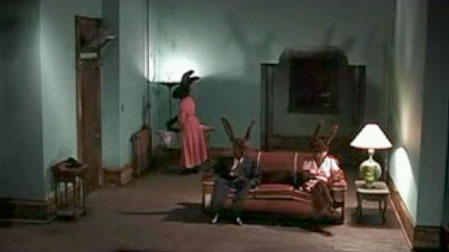
As I mentioned before, David Lynch has invaded my brain in much the same way as robots did before, so I'm going to incorporate him into my final post too. Having seen all the strange/experimental stuff he is always using I've recently been sort of interested in filmmaking. It seems like a good choice for a class.
The supplemental text used for this class would be David Lynch's Catching the Big Fish, which is basically about how he gets all his crazy ideas. He reflects on various experiences he's had making films, his favourite actors and such. The most interesting part is probably his discussion of Transcendental Meditation, which he has practised since the '70s, and from which he apparently gets a good deal of his ideas (another big one would be improvisation). We wouldn't necessarily be learning TM (though David Lynch actually has a "David Lynch Foundation" that provides scholarships for students to learn it so it is a possibility actually) but the book is a good way to learn about the creative process that goes into filmmaking.
The class would be in the form of a blog using a format similar to this one. There would be sporadic assignments (much fewer than the amount for this class, because we would do other work) on the blog such as searching out and posting about a film blog. Every week there would be an assigned feature-length movie, which we would meet to watch (that would be the only time, per week, that we would meet) and sometimes also a short. The short (either amateur or professional) would preferably be on YouTube, for the students to watch on their own time, but if it wasn't available on the internet we would have a second (short) meeting to watch it. The students would discuss immediately after watching the movies, then later reflect about them on their blogs.
At the end of each nine-week period (it would probably be a two-semester class) everyone would make their own short film, preferably about a different thing each time (documentary, faux commercial, animation...). The midterm would probably be a longer and more serious attempt, possibly in groups, and I'm picturing for the final the whole class gets together and makes one huge movie and posts it on YouTube (though all of them would be posted on YouTube I guess).
So anyway, I suppose the students would be evaluated mostly by their reflections on the movies they watch...and of course the shorts that they make. And that's it, really. I think it's a good class idea and even for students with no plans to go into film it could potentially be a good creative experience.

18 May 2008

[ the opp ]

Commenting on Laura's post (Chuck Palahniuk) this week.
That kind of stuff happens to me all the time, probably because my computer is nearly as ancient as the ones in the Powder Room (it can't be newer than six or seven years old...and I think the hard drive has had to be completely replaced twice). Anyway, I actually haven't read any Palahniuk books before but I generally love postmodern literature (The Raw Shark Texts, which I posted about, comes to mind, as does House of Leaves). Right now I'm not reading anything too postmodern, just the final Dune book plus Huckleberry Finn for Essential Books, but I do have a book on reserve at the library called The Quiet Girl (by Peter Høeg) which is about a Danish clown, suspicious psychic children, and nuns. It's actually been criticised for being too postmodern, which to be honest makes me want to read it more. Any suggestions for other books?

17 May 2008

[ the oc part ii ]

Earlier in this class you probably got tired of me talking about robots; well, now you can be tired of me posting about David Lynch, because I'm doing it again. Anyway, his first movie was Eraserhead, which is totally incomprehensible and largely lacks a plot. It's a horror movie, but it's so bizarre that to anyone who hasn't seen it it sounds like a comedy. This is summed up nicely by TV Tropes: Whenever this contributor tries to describe Eraserhead to someone, they always think it's a comedy. "This guy finds out that his girlfriend has had his baby, so they get married, but the baby is an embalmed cow foetus and its crying drives the girl away, so the guy has to raise it by himself, and a deformed lady lives inside his radiator and a topless guy with burned skin wanders around and he dreams that a giant penis bursts out of his neck and knocks his head off and a small boy sells his brain to make erasers. Oh, yeah, and throughout the film, he has to fight giant mutated sperm." And there's a dinner scene involving man-made miniature chickens. The "giant penis" mentioned is actually the head of the mutant cow-foetus baby, whose head is admittedly sort of phallic, but either way it makes no sense. For his next two movies after Eraserhead the weird was sort of inherently toned down because The Elephant Man was based on a true story (of the "elephant man" Joseph Merrick) and Dune was an adaptation of the book of the same name. His more recent movies appear to be approaching Eraserhead-like weirdness, though. I think this IMDb summary probably gives a good idea of the level of strangeness achieved by his movie Lost Highway: After a bizarre encounter at a party, a jazz saxophonist is framed for the murder of his wife and sent to prison, where he inexplicably morphs into a young mechanic and begins leading a new life. This plot is apparently taken completely seriously and treated as a film noir, but it's as nonsensical as it sounds: most reviews I've seen say it's even weirder than Eraserhead, which is a near-impossible feat. And INLAND EMPIRE is supposed to be stranger still...as evidenced by David Lynch's promoting the film by sitting around with a cow on a leash. When questioned, he explained, "Cheese is made from milk." I haven't seen either of the aforementioned movies yet, but having seen two of his others plus most of Twin Peaks I'm looking forward to them.

15 May 2008

[ the oc part i ]

I don't know how many of you have heard this but Bush recently claimed that he gave up golf so he could empathise with dead troops and their families. Seriously, golf? Because, of course, having lost the privelege of playing golf you can relate so well with people who lost their sons and daughters in the war?? And not only is Bush's claimed attempt at relating with troops and their families lame and entertainingly pitiful, he doesn't even follow through with it: he claims to have given up golfing in August 2003...except a video from October of that year shows him happily swinging away.
And speaking of slimy Republicans, anyone catch the speech that McCain delivered today? I missed it, but apparently, he laughably believes that the Iraq war can be "won" and that that Osama bin Laden can be caught. He also said that despite our "winning" the war by the end of his projected first term, only "most" of the soldiers will be sent home. When questioned about whether this represented a timetable for getting the troops home, he fired off a non-sequitur comeback: "It's not a timetable, it's victory!" Huh?

14 May 2008

[ reading reflection and response ]

The Warren Harding Error seems pretty common and Gladwell was pretty accurate in identifying it. I went to the IAT website and took a few of the tests, which seemed to work quite well (though Gladwell's representation of it in the book seemed largely incomprehensible). It's really interesting and sort of frightening how different what people feel deep down inside and what they think they feel can be. Lots of people deny some of their less "politically-correct" feelings because it makes them feel uncomfortable about themselves, but for a lot of people they're very much there, buried in a "somewhere" they'd rather forget about. My mom recently received an email from her half-sister about the presidential candidates in which she said she didn't like Obama because he was "sneaky." My mom and I agree on two things: Hillary is definitely the "sneaky" one, and the dislike for Obama is probably just repressed racism (her half-siblings' household was apparently a very racist environment).
Another interesting part in the reading was the little segment about improvisation: you just sort of assume that improvisational comedy is totally free-form but it's actually a very structured process with the actors rehearsing a lot before performances. "...improv is an art form governed by a series of rules," says Gladwell, not "zany, impulsive, and free-spirited" like you'd expect.

11 May 2008

[ the opp ]

The OPP is getting increasingly hard to do since less and less people are posting, so we have less and less resources to make OPP posts from. So for this week I'll temporarily revive the old Research and Linking category to use in place of it. So I had some blogs bookmarked on my favourites page from a long time ago, so I would have resources for my Research and Linking posts, which of course didn't happen. So I looked through what I had there and my favourite was "Wonky Socks," a blog showcasing various bits of "weird news." Here's the link. It doesn't appear to be that active; there aren't many comments or visitor activity (it appears no one has commented since February and the current poll has only fourteen voters including me) but it's still active, with posts as recent as today.
Anyway, I think the OPP should be gotten rid of or changed for these last few weeks of class. If we get rid of it entirely I think perhaps it should be replaced with Research and Linking like I did with this post.

[ the oc part i ]

Hmm, it was never really said what to actually write about for this one. So, on the topic of To Kill a Mockingbird: I've never read it, but I saw the movie years and years ago. I don't really remember any of it, thankfully, except for a vague image of Atticus Finch sitting on his porch or something. So when I do read the book, which I plan to do eventually, nothing will really be spoiled. And on the topic of wrongful accusations: it doesn't really surprise me how many wrongful convictions there are since it's so easy for people to turn away and not think about it; or if at all, "well at least someone's getting locked up for it." I think it's great that these DNA tests will help so many people out but I'm worried that since as far as I know this program only exists for already-convicted people, in the future the wrong people will still get sent to prison.

09 May 2008

[ the oc part ii ]

I'm not really a big fan of any news network. The only one that I really can't stand is FOX (its "Fair and Balanced" slogan is absolutely hilarious considering it's, well, FOX). I'm not too fond of the others either as they all have obnoxious reporters and anchors to a certain degree plus lots of political bias. CNN is probably the one I dislike the least but this is obviously an attempt to make a quick buck and a pretty lame one at that. At least the headlines selected for T-shirtdom are vaguely humorous or at least appear to be attempts at humour. Most seem to be stupid, but at least there's a thought process to it (at least they understand that no one wants to wear a headline like, say, "Police: 10-year-old raped, gives birth," but they don't seem to understand what headlines are actually funny).

07 May 2008

[ reading reflection and response ]

This chapter was unfortunately not as captivating as the intro led me to believe but Blink still seems to be a good book and a much better one than The Tipping Point. The most interesting part was probably the priming experiment that subliminally made people act like senior citizens. Pretty humorous concept, and an appropriately humorous execution: people are forced to construct sentences about wrinkles, bingo, and Florida. They don't know it, though; they just think they've been given a few words to slap together into sentences. But all that talk of aging and retirement-home pastimes has them shuffling about, wheezing, and taking copious amounts of medicine just like real old people. OK, so just shuffling about, but it was a funny image. But anyway, the priming experiments really did make them walk slowly like genuine seniors after taking their tests. And there are other types of this experiment, too: another example given in the book is a second type of sentence test that makes the testee either angry and irritable or polite and easygoing (as demonstrated by their interrupting or not interrupting of someone speaking). None of these tests work, of course, if the subjects know their behaviour is intended to be modified.

04 May 2008

[ the opp ]

Allie's book, Witch-Hunt, sounds pretty interesting and seems to deal with the same issue of "human nature" that I discussed in my horse post. That issue is that people and society in general will abandon logic whenever it can if it can submit to human nature, which requires no understanding. Human nature here, in this case, is to single out scapegoats; while today, three hundred years after the book's setting, there are of course no witch-hunts, but the same issue arises. Three hundred years ago, it was strange women; sixty years ago it was Jews, and X years from now Y group will without question be blamed for Z problem. This type of thing never goes away. Sad, really.

03 May 2008

[ the oc part ii ]

I think in an earlier post (book vs movie?) I mentioned David Lynch. If you're not familiar with him, he's one of the strangest, most awesome film directors ever. I've actually only seen one of his movies (and a substantial amount of clips from others) but I've also seen quite a lot of his TV show Twin Peaks. It unfortunately only ran two seasons but while it lasted it was a strange blend of drama, really bizarre humour ("Don't drink that coffee! There was a fish in the percolator!"), horror, and David Lynch's signature surrealism. If you'd like a sample of the series' weirdness, here's a couple videos:

a dream sequence involving a one-armed man, a dancing dwarf, an inexplicable square shadow, and a lot of talking backwards

an example of the series' strange music, plus an even stranger meta-reference in which a character calls it dreamy and does "an anachronistic 1950s dance" to it

solving mysteries using Tibetan dream-baseball

a character doing a bizarre spinning dance with a portrait of his dead daughter

There's a lot more to be found on YouTube but these are what came to mind. Check a few out, but more importantly, check out the series itself, it's great.

[ the oc part i ]

My family has a sort of thing for horse racing. At least, my grandparents did. Both my grandfathers watched and bet on horse races, and according to my parents, they were both pretty obsessive. Neither of my parents are into it, nor am I, but I'm sure at least some of my ancestors prior to my grandparents had to have liked it. Anyway, I'd say it amazes me that horse racing continues to be legal with all the injuries, deaths and abuses surrounding it but it doesn't. It's just an illogical (if you insist on calling it a) "sport" (as in, "why do people derive entertainment from this?", not "why is this still around?") but I suppose logic is always subverted by primitive "human nature," and if human nature tells us "why don't you take a number of large animals and make them run around a dirt track for your amusement" we don't ask "why is this amusing?"; we ask "how long should the track be?".

29 April 2008

[ reading reflection and response ]

I think our class can breathe a collective sigh of relief because if the small portion of Blink we've read is any indication (and if the Thin Slices theory is to be believed then it is) then the book is much better than The Tipping Point. It seems so far both to cover a more interesting topic and to be better-written. The descriptions are still a little drawn-out like in Tipping Point but he seems much better in this at getting to the point. That point, in the intro and first chapter, is probably that from experience, we can tell whether something looks "right" or "wrong" just by taking a glance at it. He mentions that in different fields when this sense is particularly developed it has different names: in basketball, it's "court sense" and in the military it's "coup d'oeil" ("the power of a glance", but I think it literally means "the blow of the eye," which sounds pretty strange in English).
So far so good.

20 April 2008

[ the opp ]

For this week I think I'm going to do a sort of strange OPP. Rather than comment on someone's post I'm going to comment on the lack thereof. Currently, a lot of the people in this class seem not to be posting anymore but a lot of us are more borderline; as in, some people haven't posted since February so they're obviously out. But a lot of people who don't seem to be doing any posting now have posted as recently as mid-March. So who's in and who's out? Do we (everyone still posting) not know something; have the people who are dropping told Jen, but she just hasn't told us? Or is it just me and for some reason I don't know? This last week or so when looking for posts to comment on I've been confused as to who's dropped (and thus, who not to comment on). Anyone else's thoughts on this?

17 April 2008

[ the oc part ii ]

To be honest I don't know all that much about personal finance issues, but I think that I'd probably have done better than average on the finance test in question considering how low (which doesn't surprise me) the scores were. Most people seem to be lacking in some simple common sense when it comes to things they can't afford; chiefly houses and cars. It seems that people think they can afford a $400 000 house and matching $70 000 car just because they make slightly more than a McDonald's worker. When their phone rings 24 hours a day because debt collectors are after them, they'll get no sympathy from me. So while I guess I'm better at financing than the "average" American consumer (that is, the person graduating 50th in a class of 49 green vegetables and one person) when it comes to common sense I have virtually no knowledge of the more complex issues. I think this situation probably describes most of us in this class (decent at financing but just not knowledgeable enough) so all of us who haven't yet taken Rick's finance class (which includes me) should do so next time he offers it.

16 April 2008

[ the oc part i ]

I've never really tried to access any personal info on a Linworth computer (except unsuccessfully trying to blog for this class at one point). I don't blog outside of this class either, so I have no real reason to access such things on school computers but I could see why some people would often want to. I think that in most cases it's fine. It would probably be better to use a laptop or similar (cell phone internet?) but I don't have a real problem with people doing it on school computers either. The only issue that I would be worried about is that the personal pages accessed by people are readily accessible to everyone else via the history page; which isn't to say that students at Linworth aren't trustworthy with such information as much as that that's just an uncomfortable position to be in. I'm not too familiar with Macs so I don't know if there's a history-delete option but if there's not I would avoid accessing pages with lots of personal information just for peace of mind. Other than that I can't see any problems.

15 April 2008

[ reading reflection and response ]

Hmm, I think that while the opinions on Tipping Point were mixed we generally weren't that fond of it. Blink looks a little better but I think we'd probably be better off doing other things. The podcasts sound like a good idea though they don't really fit in with the reading (and we lose that nice alliteration in the title, but that could be circumvented with an Elmer Fudd accent: Watching Wefwection and Wesponse; or Engrish: Ristening Refrection and Response...?) Anyway, I like that idea and think we should go with it, though I think we discussed independent books before and I still think that would be a good idea too...a mix of both?

03 April 2008

[ the opp ]

I suppose it's sort of weird to do a comment post on someone else's comment post, which this sort of is, but I'm going to do this anyway. Dylan's book vs movie post inspired a lot of discussion (three comments plus Kathryn's OPP post) and so naturally, as an avid reader/watcher of books/movies, I wanted to get in on the discussion myself. I really enjoy both mediums. I read constantly and pretty consistently watch one or more movies a week, so I've been exposed to a lot of each and I think I'm going to have to go with popular opinion (here, at least) and say that when confronted with "the book" and "the movie" I would ultimately choose "the book." A well-directed movie can ooze with style, but a book definitely presents us, normally, with more plot details and your little mental movie of it as you read is whatever "style" you want it to be (and keeping in mind what a poorly-directed movie can be like...why risk it?). I'm not discounting book-of-the-movie treatments entirely, as there have been ones I've liked, but I'd rather have, generally, the book. (Notable among the book-movies I've actually liked being David Lynch's Dune adaptation because most critics hated it for the same reason I love it: because it's, well, David Lynch. You know: incomprehensible, visually weird, and having the ability to make you feel strangely uncomfortable, that sort of thing. It works surprisingly well applied to the Dune universe, though I'm in the minority thinking that.) While "the movie of the book" is most common we also see novelisations sometimes. I haven't really been exposed to any movie novelisations but they presumably expand the content a bit (though probably against the writer's or director's wishes). But occasionally we see something truly horrible (and hilariously illogical): the book of the movie of the book. "These," according to TVTropes (which will ruin your life) "are almost always execrable, vastly shorter than the original book, or both." (Here's their whole page on The Film of the Book, as they call it, which is where that passage came from.) Another uncommon form of film adaptation is "the movie of the movie." Now normally, this would just be called a remake, but sometimes they cross that line, whether it's major additions and subtractions to the plot or the fact that the later movie is only sort of based on the earlier one. These more radical adaptations are slightly more common than you'd imagine (the first Star Wars movie is apparently an adaptation of sorts of a Japanese samurai movie from the '50s...seriously) but still not seen often. The movie I watched last week (on Friday, as I usually do, so it's still pretty fresh in my mind right now), Twelve Monkeys, is one of those. It's based on a French movie called La Jetée ("The Pier"). I haven't seen the original, as it's probably not available here, but Twelve Monkeys is much too different to be considered a straight adaptation. This is partly because of the nature of the source material (La Jetée is under half an hour, black and white, and made up almost entirely of still images; Twelve Monkeys moves, is in colour, and is over two hours long) and partly because the director, Terry Gilliam, is pretty "different" himself (he was the animator for Monty Python and co-directed M.P. and the Holy Grail). Would I choose the original over Twelve Monkeys? I don't know, but I'd still check it out. The movie of the movie is the only type of adaptation that I'm really ambivalent about. OK, so rather than risk going on another massive tangent, I'm going to render my verdict now: books > book movies. I suppose this was pretty long-winded for such a brief conclusion but oh well.

[ reading reflection and response ]

The Raw Shark Texts: I read this book last summer and instantly loved it. It's about a guy named Eric Sanderson who wakes up one day with no knowledge of who or where he is. He finds that he has a cat and a psychologist, the latter of whom he goes to see courtesy of directions in a note left by "The First Eric Sanderson." She tells him he has dissociative fugue, a type of amnesia...but in reality, his memories have been eaten by a "conceptual shark" called the Ludovician. The book is sort of a combination of the absurd and the serious. We see a guy named Mr Nobody who melts if he doesn't take personality supplement pills (and who infects Eric with an "idea lamprey" by concealing it in a copy of The Origin of Species with most words replaced with "plant"); a "computer virus mosquito in amber"; a guy from the nineteenth century who becomes immortal by hypnotising people (inadvertently causing a present-day world takeover attempt via the internet); a recreation of the final scene in Jaws in a conceptual fishing boat on a conceptual ocean, and many many more such things (including, of course, the Ludovician and other "conceptual fish"), many with no explanation at all. Times are also treated interchangeably with places ("The First Eric Sanderson" sends Eric letters from the past, complete with lines like "It's raining here in the past. I hope the weather there in the future is better."). The book also gives a name to "the labelless car parks, crawl tunnels, disused attics and cellars, bunkers, maintenance corridors, derelict industrial estates, boarded-up houses, smashed-windowed condemned factories, offlined power plants, underground facilities, storerooms, abandoned hospitals, fire escapes, rooftops, vaults, crumbling churches with dangerous spires, gutted mills, Victorian sewers, dark tunnels, passageways, ventilation systems, stairwells, lifts, the dingy winding corridors behind shop changing rooms, the pockets of no-name-place under manhole covers and behind the overgrow of railway sidings," and that is un-space, which is charted and researched by the secret Un-Space Exploration Committee. It's hard to take a book as bizarre as this seriously, but it's such a good book, you (sort of) do.

02 April 2008

[ the oc part i ]

By now I'm sure everyone is sick of hearing about Iraq. Just about every day there seems to be a headline that goes something like "(insert form of terrorism here) kills (insert number of people here) in (insert Iraqi city here)" and the efforts of a few foreigners skulking around in army uniforms (us) won't change that. Besides, the whole "war on terror" was obviously just a way for Bush to make a scapegoat out of one the most hated and misunderstood groups in America (does this remind you of anyone? oh yeah, Hitler), Middle Easterners. The populace should have identified this almost straight away but alas, the intellectual capacity of the average person constituting a wad of "the populace" is comparable to that of a vegetable. And now the war in Iran that (guess who) Bush seems to be gearing up for is based on the same principal, except the term "weapons of mass destruction" has largely been replaced with the sort-of-synonymous "nuclear weapons" (or, as it is so eloquently expectorated by our president, "nuke-u-lar"). The "Iraq war" that came before this one was slightly justified because it was supported by thirty or so nations, but only seems less ridiculous than this one until you realise that it was mostly organised by Bush Senior. Like father, like son I guess.

01 April 2008

[ the oc part ii ]

I of course haven't done an interim yet, so I can't comment on most of the things suggested, but I love Jen's idea of teachers forming "interim groups." I'm one of those people who usually takes more time straining to think of what to do than actually doing, but luckily I was sort of spoon-fed this year (my mom's friend actually had the idea for my interim, as she knows someone who teaches French who I'll be working with). The next two years, though, I project having trouble thinking of something so I think having the option of joining a group is a nice alternative if you simply can't think of a project on your own. That said I probably wouldn't recommend doing it every interim, otherwise lots of people would just use it as an easy way out of thinking for themselves. I think one year would probably be a good limit, sort of similar to having to do at least one year's interim with a mentor.

16 March 2008

[ the opp ]

I was immediately interested by Michelle's post on materialism because in Walt and Ralph we're studying Thoreau's (who Michelle quoted) Self-Reliance. He obviously had some similar ideas to these and in class most of us agreed that Self-Reliance was a better essay than the ones we had previously read. It was essentially a discussion of how people had softened from their original tough and resilient state...and considering that that was written two centuries ago, we've softened a lot more after his time. I think Thoreau mentioned in Self-Reliance something along the lines of if you strike a "primitive" person with an axe the wound would be healed in a week and the same wound to a modern person would kill him, so in a way we've "softened" literally too. Anyway, there's a time-saving gadget for just about everything and people seem to honestly believe that they need each and every one of them. We definitely rely on things like these gadgets, plus instant gratification like mindless TV, way too much.

[ reading reflection and response ]

In Gladwell's signature style, this chapter was painfully choppy and could have been a lot more unified in its message, but he clearly has some good ideas. The Ya-Ya Sisterhood passage didn't really seem to relate to anything. It doesn't relate to the Rule of 150. It would work better in the previous chapter, considering it's more of an awkward continuation of that chapter that Gladwell makes as he gets his footing in this one. It does sort of fit in better as the chapter moves along, but the only connection seems to be that the Ya-Ya epidemic was tipped by groups. Moving on, Linworth is an obvious product of the Rule of 150. If we had significantly less students, it would be dull, but with more students it might end up feeling like a "regular" high school (plus, there's the fact that the school is probably only large enough to hold the current number of students).

15 March 2008

[ the oc part ii ]

You are probably tired of me discussing robots on this blog.
Too bad.
Anyway, I have found yet another excuse to write about robots. This time it's robots...in space. As a rule, if you take something and put it in space, chances are it becomes twice as cool. Now not only is a robot, you guessed it, being sent into outer space, it's being sent into outer space by...Canadians?
Yes, Canadians. When you hear talk of stuff in space, you probably think NASA, and so did I, so I was surprised when I took a closer look at the article and saw the words "Canadian Space Agency." The Special Purpose Dexterous Manipulator ("Dextre") was recently sent to the International Space Station by the Canadian Space Agency (though it was launched in America), where it will perform external repairs (while sitting atop something called the "Canadarm") normally done by cosmonauts. (OK, "astronauts" if you insist, since we're not talking about Russians, but that term is so inaccurate and wrong that it pains me to use it...but I'll save that rant for another time)

[ the oc part i ]

So, my thoughts on this prescription drug problem (epidemic..?). Are our youth being over-medicated? Yes, definitely. These days, people seem to load up their children on antibiotics every time they sneeze. I've never understood this mentality...haven't these people heard the words "drug-resistant bacteria"? And do they realise they're to blame for this whole mess? Considering the intelligence of the average American, and Americans' act-first-think-later (or never...) mentality, probably not. Sad. And this leads us to the much-less discussed, but far more ubiquitous and serious problem: vaccinations and "immunisations."
So you're an "average" American parent. Your kid is at the doctor's office. Says the doctor: "Your child isn't up-to-date on his immunisations." Being the gullible American you are, this of course frightens you a great deal. You immediately, without a second thought, allow the doctor (or, if we're discussing a "typical" case here, an inept nurse with even less knowledge of medicine than you) to insert a suspicious needle into some part of your child's body.
So what's in there, huh, doc?
Oh yeah, he just injected a freaking disease into your child's body. Real smart move, parent.

23 February 2008

[ the oc part ii ]

I don't think school shootings are becoming a regular thing, but they are happening way too often. I think that, like you said, we should definitely be looking at where these recent shooters came from, what they did and what influenced them, because you can't simply look at someone and, based on a stereotype, say "He's going to be a school shooter." Gladwell's rules, to an extent, seem to apply here. The Power of Context, though, not so much. If a shooter had an impulse or "just snapped" because of something within the school context, by the time they formulated a plan they would have cooled down and abandoned aforementioned plan. They more likely develop and build up a plan very gradually, culminating with the shooting itself. So in that respect, it doesn't really apply, but the Northern Illinois shooter did seem to me to be a Bernie Goetz kind of guy.

22 February 2008

[ reading reflection and response part ii ]

The Stanford prison experiment seems like something that just wouldn't happen today. It's so obviously unethical. If you tell someone "Hey, we want to prove that prisons are nasty places, go pretend to be a prison guard," of course they're going to be nasty themselves. Though indirectly, the guards' sadistic and abusive tendencies were encouraged and reinforced by their assigners. The strangest part is that, after the experiment was over, a few experiments were apparently conducted emulating this one despite the obviously disastrous results of the original.
The lying and cheating thing seemed fairly obvious to me: everyone cheats to a certain degree on certain things. It's in human nature. I suppose the extent of it is a lot broader than I'd imagined though, like who cheats on what on a certain test changing simply because of the situation the test was given in. The Good Samaritan experiment I found a little more surprising. It's only natural to conclude that the student studying the Good Samaritan would stop and help the person...though I suppose this shouldn't be surprising, as the story seems to demonstrate that an otherwise "worthy, pious man," as Gladwell calls him, might not stop and help someone in need.

21 February 2008

[ reading reflection and response part i ]

So, after the light and interesting chapter three this one seemed particularly dry and dense. I, to be honest, felt like I was re-reading the first chapter. It was essentially the same story, only with Baltimore and syphilis replaced with New York and violent crimes. It was the same time period (nineties) same setting (highly populated urban area) and (I think this is what topped off the feeling of déjà vu for me) in both scenarios, the "push" that caused the epidemic to tip was crack cocaine. In Baltimore, the slums were being demolished and the outpouring of highly sexually active people, plus some crack to impair the people's judgement some more, "tipped" the syphilis outbreak. In New York, reduction in crack use was considered one of the major factors causing the drop in violent crimes. Just thought that was sort of interesting.
Anyway, I think the Broken Windows theory was pretty intriguing. I never really thought of it this way but the idea that by fixing up a facility you are deterring criminal activity around that facility seems so simple and obvious after reading the chapter. I like it.

19 February 2008

[ the oc part i ]

Hmm. I really wouldn't change much about this class at all. I like the way it's working currently. I might up the number of comments like Miriam said though, because we could get into some more interesting discussions. Also, I've warmed up to Gladwell's writing a bit, but I think I would still sort of dread reading another book by him: Blink looks fairly good, but maybe next quarter, instead of reading that, we could look up books we think might be interesting, discuss them, and decide on another book to read? It'd be nice to see all the different books people come up with. (Non-fiction only?) Perhaps you should also throw in an occasional "what kind of blogs do you read" assignment like the one we did for the first week, I enjoyed that one. That's all I can think of at the moment.

17 February 2008

[ the oc part ii ]

I recently found this optical illusion and thought it was pretty interesting. Depending on which way you see the silhouette spinning, you're apparently using a different side of your brain. I actually saw it both ways but mostly saw it clockwise. Looks like there's a gallery of other illusions at the bottom of the page too.

[ the oc part i ]

So, I've already established this: I like robots. I've also established: I don't care much for "real" robots. I also by extension don't care for nanobots. I like my robots VISIBLE, please. They are capable of some pretty amazing things though, and according to one expert, they could be as intelligent as us by 2029. He predicts that we'll all have nanobots inside us to perform different functions: they'll ward off sicknesses, boost our intelligence and generally improve our lives...but it just screams grey goo to me.

16 February 2008

[ research and linking part ii ]

The School of the Future is an alternative school in New York. In addition to being a high school, it also accomodates kids grades six through eight. It appears to be more focused on maths and sciences than English and social studies, so it's not really my type of school, but it looks interesting. The students are taught by the same teachers for two years each, with the exceptions of sixth grade, and sometimes eleventh and twelfth grade.

[ research and linking part i ]

The Nova Project is an alternative school in Seattle. It's small, but not quite as small as Linworth (280 kids). It's a liberal arts-centric school where the students pick one staff member to be their advisor on various topics, kind of like interim or walkabout advisors, but more general. I think it's pretty notable because, according to the About page, it was created by students as well as teachers.

14 February 2008

[ reading reflection and response ]

I was actually pleasantly surprised to find myself agreeing with Gladwell quite a lot in this chapter. I never really would have thought to call something "too clever," but with Sesame Street it really seems to apply. Celebrities, pop culture references, subtle wordplay...none of these are understood by toddlers and all of these are parts of Sesame Street. Though these all make the show enjoyable to watch for parents, there's no point in getting parents to watch educational shows with their kids if they can't explain the show to those kids. Blue's Clues, though hopelessly dull for parents, seems to be a better show for its target audience of preschoolers.

12 February 2008

[ reading reflection and response part ii ]

Malcolm in this chapter was flapping his lips even more than the last chapter. He clearly cares far more about hearing himself spout meaningless descriptions and nonsense than he does about making any kind of point. His "point" here was worn down to flatness before he even tapped the first key on his keyboard. Do we care who he thinks looks like a cowboy? Do we care why the Mercury Mystique, which is, according to Wikipedia, a mediocre and overpriced car nicknamed the "Mercury Mistake," is supposedly a good car, or why said car should be bought on the twenty-fifth of the month? Padding at levels this excessive makes things unbearable dull...which Gladwell's writing is in the first place, so the idea is doubly bad here.

[ reading reflection and response part i ]

So, after cleaning as much of my brain off of the floor as I could, I decided to use what remained to take the name test advised by Malcolm in chapter two. It has to be one of the most foolish things ever. Knowing someone's name does NOT make you a "connector." You could bump into someone, exchange names, and never see each other again, and if every single one of the names on the list you knew were memories of such experiences, says Gladwell, you're still a connector. Stupid. He makes no distinction. Another thing that he apparently makes no distinction in is name choices, as these are some of the oddest, most uncommon names, excluding my own, that I've ever seen. As such, these are presumably derived from his OWN memories (as given away by his pompous, none-too-subtle inclusion of the name Gladwell), so who's to say he has any idea of how to connect with people, let alone write about doing so?

10 February 2008

[ research and linking part ii ]

The I Hate Bush Fan Club is a political blog with similar views to those of the blog I posted earlier, but presented in a decidedly more biting fashion. A few videos are interspersed her and there. I haven't delved very far into the post history, but the posts themselves seem somewhat infrequent, with only a few each month.

09 February 2008

[ research and linking part i ]

YOUTHinkLeft is, as its fairly clever name implies, a youth-oriented and youth-run political blog. Liberal teens and young adults from all across America write their commentaries there. Its two main focuses seem to be the flagrant offenses of the Bush administartion and, more importantly, the election that will soon end the administration.

[ the oc part ii ]

It's no secret: Doctor Who's immense popularity in the UK is partly because of the (unintentionally loveable) Daleks. Us being Americans, some of you are probably thinking "Dal-who?" (Or, for that matter, "Doctor Who who?") They were introduced in the second serial of the show and generated lots of public interest for it, much of which came from their unusual and fairly amusing appearance: they reside in robotic casings that look, honestly, like salt or pepper shakers. They have no heads, just a single protruding, swivelling eyestalk. Also, their arms (I am not making this up) resemble toilet plungers. And to top it off? The Daleks' design was based on ballerinas! The resulting "skirted" design, while giving them a graceful gliding motion, also makes them pretty immobile. They are sometimes incapacitated simply by placing an article of clothing over them. So naturally, while ostensibly the most supremely evil race in the Doctor Who universe, they're pretty funny. Perhaps the most hilarious part about them is that despite all this, they almost universally terrify small children. Maybe this is because of the music...

04 February 2008

[ the oc part i ]

In my opinion, Target and the blog are both at fault. Because Target's problems are more blatant, I'll start with the blog: for starters, it's run by a middle-aged woman. This just screams "overbearing, overprotective mother." If it's that relevant to teenagers, I'd certainly like to see some teenagers blogging about it. I do respect the apparently quite large amount of work she does environmentally, but just about everything else she posts looks uninteresting and, I'm sorry, insipid. She generally seemed condescending to the teens she tries to "protect" from the media, thus being disconnected from what they actually feel THEY need protection from. In addition, she might not even have a teenager herself; listen to this quote from a post of hers:

Yesterday my 12-year old got into BigThink after bball out of the blue, rambling on with a gal pal about “where space ends, new beginnings into other worlds, black holes, how do we feel things, how do we speak, where did languages start, what if none of it’s real and this is all in our minds”…Whoa.

Any normal twelve-year-old would contemplate such things. If she thinks that's something really special she really needs to get in touch with reality. And onto the subject at hand: whether or not she has a teenager. A twelve-year-old girl, no matter what explanations this woman would probably try to come up with, is not a teenager. She is a tween, and while tweens desperately want to be, they are not teens in any sense. Perhaps this woman has other, older sons or daughters, but we'll never know, as her profile helpfully repeats the same thing three times in a row. Also, "bball."
Anyway, Target. Their obvious problem is that they are too blind to realise that most of their customers probably "cooperate with nontraditional media outlets" for most of their "media," as they so pretentiously describe blogging. If they continue to do things like this, they'll lose customers, fast.

03 February 2008

[ reading reflection and response ]

I recently finished the required reading for The Tipping Point. It was a useful tool for identifying trends. Unfortunately, it would also serve as a useful tool for putting oneself to sleep: Gladwell presents a lot of interesting points in the most fiercely boring, brain-atrophy-inducing way possible. The speed-reading technique I learned in BUM was useful here. I did, though, enjoy the book, brain atrophy aside. ("Hey, um, is that your brain trickling out of your ears there?" "What, this? I think so, never mind that; hey, try this book, it's great!" Repeat ad infinitum, and we'll have a Gladwell-esque zombie epidemic on our hands...) I liked a lot of the ideas Gladwell put forth, but I though the one on "stickiness" was a little narrow and weaker than the rest. Like, for example: a syphilis outbreak is NOT going to occur just because someone makes up a catchy phrase that promotes contracting it. On an unrelated note, we actually discussed Kitty Genovese in law class last semester. The bystanders' indifference was the result of the so-called "bystander effect," which Gladwell mentions, but not in name. According to the Wiki article on the bystander effect, this particular case of it is so famous that some call it the "Genovese effect."

02 February 2008

[ the oc part i ]

I was very surprised after reading this article...though I suppose I shouldn't have been. Over and over, I have seen proof that the world is run by incompetants and there's nothing we can do to stop them from continuing to do so, as they are in the majority, and the majority controls everything. It's pathetic how little people actually get done when doing their jobs. I don't care how much "creating new jobs" bolsters the economy, because if everyone working those new jobs is inept, half-asleep, and possibly drug-addicted, then it's certainly not helping anyone on the receiving end of their shoddy work. As for the situation in question, it's pathetic; handwashing takes ten seconds at the most, and the majority of medical facilities provide convenient stations where workers can do so...that is, unless said facilities were designed by yet more incompetants.

[ the oc part ii ]

Should I care that Heath Ledger is dead? Frankly, I felt very little emotion when I heard about his death. I try to distance myself from the activities of celebrities because I think sticking your nose in every little thing they do is both foolish and an invasion of privacy. Well, in the case of Heath Ledger, the latter doesn't really apply, because dead people lack any semblance of privacy anyway. "Hey, Bob is being buried today, come and see his remains!" There's really no equivalent of this for a living person. Though I think my lack of reaction to Heath Ledger's death is partially because I also had very little knowledge of him, I still don't think the media should get itself into a frenzy just because someone died. Celebrities are people too. Just think of it this way: are the obituaries on the front page of the newspaper?

30 January 2008

[ research and linking part ii ]

So, what's something that I like that isn't LEGO? Robots. I love robots. I really don't understand why, but I'm drawn to anything robotic. I tried to search for a robot blog to use for this class, but most were painfully stodgy, technical blogs featuring lifeless "robots" that were mostly just autonomous sets of wheels that didn't DO anything. They just rolled around...autonomously. Fascinating. The average blog post, too, read something like "I installed five servomotors on my robot today!" Except that these posts, with a potential brevity of about one sentence, took every opportunity to drudge on for appoximately five years. These definitely weren't my kind of robots.
I'm more interested in, well...everything the aforementioned mind-numbing blogs aren't. Fictional (or at least semi-interesting) robots. The only blog I could find relating to such things was Suicide Bots. It mostly focuses on robots in internet pop culture. I couldn't see myself coming to the site every day, but it's worth visiting for the videos, such as this fight between a toy robot and a puppy (complete with inexplicable Super Mario Bros. sound effects) or this Japanese beer-pouring robot.

29 January 2008

[ research and linking part i ]

As you may and probably do NOT know, I like LEGOs. (As you probably DO know if you visited Google yesterday, the 28th was "LEGO Day," the 50th anniversary of the LEGO brick.)
I visit quite a few LEGO sites where users post their creations, and it's amazing how far fans can go with a simple arsenal of plastic parts; some creations are five or more feet long with attention to detail to match, a feat most outside the fanbase couldn't even conceive of.
A blog that I recently found and started reading more or less daily is The Brothers Brick. Essentially, it's a showcase for the best and most thought-provoking fan creations. Most of the time, they aren't posted by the builders themselves. They are usually taken from other LEGO sites like Classic-Space (a sci-fi and space-centric LEGO site) and LUGNET (a more general site). The posts themselves are typically terse, usually comprising a picture, a possibly-witty sentence or two, and a link to a gallery of related images. I like this format because it gets right to the topic at hand and doesn't ramble on for ten hours so you can see a few pictures and say "Oh cool, like, LEGOs."
Though someone more familiar with LEGO could probably derive more enjoyment from this blog, I recommend it for any who is interested in or unfamiliar with LEGOs so they can see all the intriguing and clever ways fans manipulate them.

[ blog is up ]

So I've done a little with the profile and such...unfortunately, Blogger's vegetable-like IQ doesn't comprehend the simple idea of "hey, I want more than one space in there," so the title and its fellow bits of bracketed text aren't spaced out as I planned, making them significantly less cool than I desired. Oh well.